These are the first lot of questions for the evaluation of my preliminary task...
1. What did you find easy when working on your preliminary task?
I found editing to be the most easiest to do while working on my preliminary task, purely because you can edit most of the mistakes out, you can change things, undo what you removed or have added and it's just easier than filming the whole thing. Also, the whole can decide on what looks good so you know if you have done it right. Also, filming was pretty easy, however there were times where I may have accidentally forgotten to not laugh while filming and having my voice caught in certain clips!
2. What was the most difficult part when you were working on your preliminary task?
I don't know what was the most difficult part while working on my preliminary task. I guess storyboarding and planning was the most difficult as we didn't know what to base our practice task on. Filming was a little difficult as we had to find areas where there wasn't much 'traffic' like teachers or students walking past. But other than that, it seemed quite easy to make.
Sunday, 10 February 2013

Filming Schedule...
This is the finalised shooting schedule for our film, we have managed to organise the filming within three weeks including half term. We have also done the risk assessment, and are now getting ready to start filming.

Main Storyboard...
Once we got all of our main ideas sorted, we then went onto storyboarding our film opening. We did this using post it notes, this was so that if we didn't like where a certain shot was, or if we wanted to add or remove a shot we could easily. We then glued them down once we were happy with the final choice of shots...

 Shot 5:
Close up & tilt. (Moves up to belt)
Shot 6:
Close up & tilt. (Shows gun in belt)
Shot 7:
Close up & tilt. (Jacket being put on)
Shot 8:
Close up & tracking shot of feet walking down the stairs.
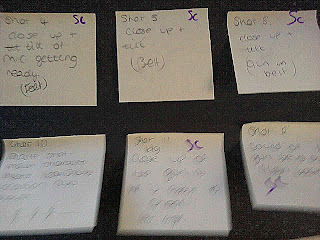 Shot 9:
Medium shot from behind. (Opens door, walks out)
Shot 10:
Master shot. (Main character meets loan sharks) Location also shown.
Shot 11:
Big close up of the gun as he is about to shoot, low angle.
Shot 12:
Sound of gun being shot, flash back.
 Shot 13:
Arm is raised with gun in hand. Over the shoulder shot.
Shot 14:
Gun shot & flash back, happy memory, two shot. (Main Character & Wife laughing)
Shot 15:
Another flashback, big close up of hands held, couple walk away from camera, tilts upwards to show back of their heads.
shot 16:
Wide shot of house. ('6 months ago')
Shot 17:
Dialogue, two shot, cut's between them.
Shot 18:
Over the shoulder shot of wife and kid(s) walking out the door.
Shot 19:
Main character looking out of window, high angle and over the shoulder shot.

Shot 1:
Wide shot of town.
Shot 2:
Wide shot & Pan.
Shot 3:
Pan & wide shot of main character's room.
Shot 4:
Close up & tilt of main character getting ready. (Starts with feet)

Close up & tilt. (Moves up to belt)
Shot 6:
Close up & tilt. (Shows gun in belt)
Shot 7:
Close up & tilt. (Jacket being put on)
Shot 8:
Close up & tracking shot of feet walking down the stairs.

Medium shot from behind. (Opens door, walks out)
Shot 10:
Master shot. (Main character meets loan sharks) Location also shown.
Shot 11:
Big close up of the gun as he is about to shoot, low angle.
Shot 12:
Sound of gun being shot, flash back.

Arm is raised with gun in hand. Over the shoulder shot.
Shot 14:
Gun shot & flash back, happy memory, two shot. (Main Character & Wife laughing)
Shot 15:
Another flashback, big close up of hands held, couple walk away from camera, tilts upwards to show back of their heads.
shot 16:
Wide shot of house. ('6 months ago')
Shot 17:
Dialogue, two shot, cut's between them.
Shot 18:
Over the shoulder shot of wife and kid(s) walking out the door.
Shot 19:
Main character looking out of window, high angle and over the shoulder shot.
Main Film Project - Test Shots...
After storyboarding our main film opening, we decided to do some test shots, to see how the locations we chose in the school would look.
These are some of the better test shots we took, we chose some of the main scenes that we thought would be suitable for the shots we chose within the school. I tried to use different camera movements to see what would look best, for example panning, tracking etc. I also used different types of shots, for example close up, extreme close, wide shots etc.
Friday, 1 February 2013
Target Audience & Genre...
The final part of the research was to look at what genre appeals to what type of audience. We looked at gender & age. This was to give us an idea as to what audience may be interested in our film/film opening and this is what we found:
Action -
Gender: men/boys
Age: late teens/young adult - (14-17), (18-24)
Comedy -
Gender: Women (58%) Men (42%)
Age: Strong appeal to those under 25
Thriller -
Gender: Men (48%) Women (52%)
Age: Strong appeal to those under 25
Romance -
Gender: Typically a female demographic, (71%)
Age: Strong appeal to those under 25
Family Movies -
Gender: Mainly female, Women (60%) Men (40%)
Age: Strong appeal to children, and those under 40
Horror -
Gender: Both, Women (53%) Men (47%)
Age: Strong appeal to those under 25
Action -
Gender: men/boys
Age: late teens/young adult - (14-17), (18-24)
Comedy -
Gender: Women (58%) Men (42%)
Age: Strong appeal to those under 25
Thriller -
Gender: Men (48%) Women (52%)
Age: Strong appeal to those under 25
Romance -
Gender: Typically a female demographic, (71%)
Age: Strong appeal to those under 25
Family Movies -
Gender: Mainly female, Women (60%) Men (40%)
Age: Strong appeal to children, and those under 40
Horror -
Gender: Both, Women (53%) Men (47%)
Age: Strong appeal to those under 25
Regional Funding...
The second term we researched was Regional Funding. This is basically local funding which increases tourism, and helps poorer towns which aren't that well known, become known. Examples of films which have been funded by regional funding are:
- Promethious
- Goal
- Harry Potter
- James Bond
- Hot Fuzz
There are also two examples of regional funding organisations for each country which is part of the UK, these are;
- Screen West Midlands
- Wales Screen Commission
- Northern Ireland Screen
- Scottish Screen
International Co - Production...
For our main film opening we had to do some research into four areas, my group chose to research two areas; International Co-Production & Regional Funding. Firstly is International Co-Production...
International Co-Production is where two or more production companies from different countries work together to produce a film. Films that have been co - produced are:
International Co-Production is where two or more production companies from different countries work together to produce a film. Films that have been co - produced are:
- Johnny English
- Sherlock Holmes
- Harry Potter
- Inception
Canal + and an Italian film production company also worked on the film Gladiator. In total there have been 355 co-production films in the last 7 years.
Subscribe to:
Posts (Atom)